Enquiries +91 97699 99960 im@digantsharma.com

Chapter 06 · A chronology with gaps

The 63 days

Sixty-three days passed between 13 July and 13 September 1929. Reliable records exist for only a handful of them. This page shows all sixty-three — and leaves the undocumented ones empty, because inventing what happened on them would be the easiest and worst thing this archive could do.

Plate 07 Press detail
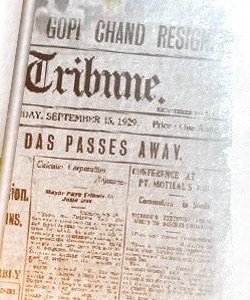
Detail of a newspaper front page showing the masthead of The Tribune, the date September 15 1929, and the headline Das Passes Away.
“Das Passes Away” — The Tribune, Lahore, 15 September 1929. Detail of the front page reporting his death, reproduced from a modern commemorative montage.
No detailed record Documented milestone Day 63 · 13 September 1929

Why this page has holes in it

A day-by-day account of Jatin Das's hunger strike would be easy to write and almost entirely fictional. The surviving record — press reports, legislative proceedings, jail correspondence, later memoirs — fixes a small number of dates firmly and says nothing reliable about the rest. It does not tell us what he did on the twenty-second day, or the fortieth, or the fifty-first.

So this page presents the strike in phases, and attaches detail only where a date can be supported. The empty stretches between them are not a design flourish and not an oversight. They are the shape of the actual evidence.

01 13 July – 13 September 1929

Sixty-three days,
as far as they are known

Beginning · 13 July 1929

Das joins the strike

Jatindra Nath Das joins the hunger strike that Bhagat Singh and Batukeshwar Dutt had begun on 15 June 1929, over the treatment of Indian political prisoners in the Lahore jails. He is twenty-four, has been in custody for a month, and has conducted a successful hunger strike once before, at Mymensingh in 1925.

Days 02 – 29 No day-by-day record for this period has been located. The strike continued; the press reported on the prisoners' condition periodically; nothing more specific can be responsibly stated here.

Escalation · approximately mid-August 1929

Force-feeding, and a widening audience

By the second month the authorities were attempting to feed the strikers forcibly, and Das's health was declining as a result; accounts record injury to his lungs. The precise dates of these attempts are not established in the sources consulted, so this entry is placed at the phase rather than the day.

Outside the prison the strike had become news. The Tribune of Lahore reported regularly on the prisoners' deteriorating condition, and the question was raised in the provincial and central legislatures.

Days 31 – 57 Four weeks for which this archive presents no specific events. The strike was continuing and Das's condition was worsening. Any further detail would be reconstruction.

Late stage · early September 1929

Release recommended — and declined

With his condition serious, the jail authorities are recorded as having recommended Das's unconditional release. The government declined and offered release on bail instead. The offer was refused, because accepting it would have conceded the point the strike existed to make.

The day number here marks the phase, not a verified date; the sources place these events in early September 1929 without fixing them to a particular day.

Days 59 – 61 Unrecorded.

Final days · 12 September 1929

A medical note

A medical report of 12 September 1929 records: “Das has fever — temperature morning 100 degrees, evening 99 degrees, pulse is 130 p.m. — very rapid.”

It is the last dated document about his condition that this archive has been able to verify. It is quoted here in full because it is one of the very few contemporaneous records of him that survives in the accessible literature — and because its flatness says more than any description could.

13 September 1929 · Friday

Day sixty-three

Jatindra Nath Das dies in prison in Lahore, in the presence of his younger brother Kiron Das. Sources give the time as one o'clock in the afternoon and place the death at the Borstal Jail, Lahore. He is twenty-four years old.

13 September 1929 · Lahore

What happened next

News of the death travelled quickly. Two days later, on 15 September 1929, The Tribune of Lahore carried it on its front page, printing a photograph with the caption “He died fighting for better treatment of political prisoners”. The historian Kama Maclean has noted that the impact of that front page on nationalist politics was such that the British subsequently stopped handing over the bodies of revolutionaries to their families.

In the Central Legislative Assembly, Motilal Nehru moved for an adjournment as a censure of the treatment of the Lahore prisoners; the motion was carried against the government by 55 votes to 47. In the Punjab Legislative Council, Mohammad Alam and Gopi Chand Bhargava resigned in protest. Within months the government appointed a jail enquiry committee in the Punjab, and the remaining strikers suspended their protest on assurances from its members that the question of the treatment of political prisoners would shortly be settled — an assurance repeated publicly in the Assembly by Sir James Crerar. The strike as a whole is generally described as having lasted 116 days.

Das's body was released to his family and carried by train from Lahore towards Calcutta. What happened along that route, and what happened when it arrived, belongs to the next chapter.
Four things this page does not claim

  • That the events shown at days 30 and 58 occurred on those exact days. Both are placed by phase; the sources date them only to a period.
  • That nothing of importance happened on the fifty-eight days left blank. Things certainly happened. They are simply not documented in the sources available to this archive.
  • That Das's fast and the wider strike are the same event. The strike began on 15 June and ran about 116 days; his own fast ran 63 days from 13 July.
  • That any quotation attributed to Das online is genuine. No verified words of his own have been located, and none are reproduced here.

Where accounts disagree

  • Start date. Some accounts date his fast from 15 June 1929 while still calling it 63 days. That is arithmetically impossible: 15 June to 13 September is 91 days. 13 July to 13 September is exactly 63.
  • Place of death. Detailed accounts say the Borstal Jail, Lahore; many summaries say Lahore Central Jail. Both refer to his imprisonment in Lahore in connection with the same case.
  • The 1925 fast. Its length at Mymensingh is given as twenty days in some accounts and twenty-one in others.
  1. 01“Jatindra Nath Das”, Wikipedia — the 13 July 1929 start, the 63-day duration, force-feeding, the release recommendation and bail offer, the medical report of 12 September 1929 (quoted), the death on 13 September 1929, and the Assembly censure motion carried 55–47. en.wikipedia.org
  2. 02“The Tribune photo on Jatin Das shook British empire”, The Tribune (Chandigarh) — the front page of 15 September 1929, its caption, and Kama Maclean's assessment of its political effect. tribuneindia.com
  3. 03“Batukeshwar Dutt”, Wikipedia — the strike begun 15 June 1929 and its overall duration of 116 days. en.wikipedia.org