Enquiries +91 97699 99960 im@digantsharma.com
Chapter 04 Punjab Province · British India Proceedings commenced July 1929 Supplementary case

Lahore, 1929

A conspiracy trial, a prison, and a dispute about how the men inside it should be treated. This chapter separates what the Lahore Conspiracy Case actually was from the compressed version that circulates in popular memory — and explains why the argument about prisoners' status mattered so much that a young man was prepared to die over it.

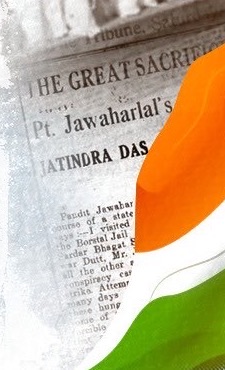
Plate 05 Press detail
Detail of a newspaper column headed The Great Sacrifice, referring to Pandit Jawaharlal, Jatindra Das, the Borstal Jail, Sardar Bhagat Singh, Dutt, the conspiracy case and a hunger strike.
Detail of a press column on Jatindra Nath Das. The visible text refers to Pandit Jawaharlal, the Borstal Jail, Sardar Bhagat Singh, Dutt, the conspiracy case and the hunger strike. Reproduced from a modern commemorative montage; the full original page was not available to this archive.
01 The proceedings

What the Lahore Conspiracy Case was

The Lahore Conspiracy Case of 1929–1930 was the colonial state's principal prosecution of the Hindustan Socialist Republican Association. It is usually remembered through its ending — the execution of Bhagat Singh, Sukhdev Thapar and Shivaram Rajguru on 23 March 1931 — but the proceedings themselves stretched across two years and drew in a much larger group of accused.

Its immediate origin lay in the killing of a British police officer, J. P. Saunders, in Lahore in December 1928, during protests against the Simon Commission. A second and separate event followed on 8 April 1929, when Bhagat Singh and Batukeshwar Dutt threw bombs from the visitors' gallery of the Central Legislative Assembly in Delhi, onto empty benches, in protest at the Public Safety Bill and the Trade Disputes Bill. The two men made no attempt to escape; the object was to be arrested and to use the courtroom as a platform.

The arrests that followed the Assembly action gave the police the opening they needed. Through the spring and summer of 1929 a much wider group was detained across northern India and brought to Lahore. Jatindra Nath Das was arrested on 14 June 1929 and was to be tried under the supplementary proceedings of the case. He never reached a verdict: he died in custody on 13 September 1929, while the case was still being heard.

02 Sequence of events

The record, in order

Each entry below is dated. Where a date is approximate or contested, it says so.

01

December 1928 — Lahore

The police officer J. P. Saunders is killed in Lahore. The killing takes place against the background of protests against the Simon Commission, the all-British constitutional commission whose composition had provoked nationwide demonstrations. The investigation into this killing becomes the spine of the prosecution that follows.

02

8 April 1929 — New Delhi

Bhagat Singh and Batukeshwar Dutt throw two bombs from the visitors' gallery of the Central Legislative Assembly onto vacant benches, in protest at the Public Safety Bill and the Trade Disputes Bill. They do not attempt to flee and are arrested at the scene.

03

14 June 1929 — Arrest of Jatindra Nath Das

Das is arrested in connection with the manufacture of explosives for the HSRA and taken to Lahore, to be tried under the supplementary proceedings of the Lahore Conspiracy Case. Accounts differ on whether the charge concerned the specific Assembly device or his wider role as the organisation's bomb-maker.

04

15 June 1929 — The hunger strike begins

Bhagat Singh and Batukeshwar Dutt begin a hunger strike over the treatment of Indian political prisoners. It is taken up over the following weeks by others held in connection with the case, and eventually becomes the longest and most widely reported prison protest of the period — generally described as having run 116 days in total.

05

13 July 1929 — Jatin Das joins

Das joins the hunger strike. Counted from this date, his fast lasts exactly sixty-three days, ending with his death on 13 September 1929. This arithmetic is the reason this archive treats 13 July, rather than 15 June, as the start of his strike.

06

July–September 1929 — Force-feeding and deterioration

The jail authorities attempt to feed the strikers forcibly. Accounts of Das's case record that these attempts injured his lungs and that his health declined seriously as a result. A medical note dated 12 September 1929 records fever and a pulse of 130.

07

September 1929 — Release recommended, and declined

The jail authorities are recorded as having recommended Das's unconditional release. The government declined, offering release on bail instead. The offer was refused: accepting bail would have conceded the very point at issue, that he was an ordinary prisoner rather than a political one.

08

13 September 1929 — Death in custody

Jatindra Nath Das dies in prison in Lahore on the sixty-third day of his fast, in the presence of his younger brother Kiron Das. Sources place the death at the Borstal Jail, Lahore; many popular accounts say Lahore Central Jail. He was twenty-four.

09

23 March 1931 — The case concludes

Bhagat Singh, Sukhdev Thapar and Shivaram Rajguru are executed in Lahore. Das had by then been dead for eighteen months, and had become one of the case's most widely known figures without ever having been convicted of anything in it.

03 The demands

What the prisoners were asking for

The dispute was about classification. Indian prison rules of the period drew distinctions between categories of prisoner, and those distinctions determined diet, clothing, labour, correspondence and access to reading matter. European prisoners were, in practice, treated substantially better than Indian ones. Indians convicted or detained for political offences were, as a rule, held on the same terms as ordinary criminal convicts.

The prisoners in Lahore argued that a person imprisoned for a political motive was in a different position from a person imprisoned for personal gain, and should be treated accordingly. That claim — that motive is relevant to how the state may treat someone it has locked up — is the intellectual core of the whole episode, and it is what makes it more than a prison grievance.

The clearest surviving statement of the demands is a letter the Lahore Conspiracy Case under-trials issued on 28 January 1930, several months after Das's death, restating what they had been asking for. Its terms are summarised opposite.
01

LabourThat “no political prisoner, whatever his offence may be, should be given any hard and undignified labour for which he may not feel aptitude”.

02

HousingThat all political prisoners held in one jail should be housed together in the same ward, rather than dispersed among the general prison population.

03

NewspapersAccess to at least one standard daily newspaper, in an Indian language or in English.

04

StudyThat “full and proper facilities for study should be granted” — books and writing materials, for men who were in most cases students.

05

Diet and clothingPermission to supplement the prison provision of food and clothing from private sources at the prisoner's own expense.

06

ClassificationRecognition of political prisoners as a distinct category, with motive treated as “the most important factor in the criteria for classification”.

Source: statement of the Lahore Conspiracy Case under-trials, 28 January 1930.

Why this was worth a hunger strike

These are not luxuries. Adequate food, clean clothing, exemption from degrading labour, the company of one's fellows and access to books are the difference between imprisonment and destruction. The prisoners were arguing that a state which claimed to rule by law could not simultaneously treat its political opponents as sub-legal. The hunger strike was the only instrument available to men who had no vote, no press access and no court that would hear them on the point.

This archive describes the strike as a documented historical event. It does not present starvation as admirable in itself, and it contains no description of how such a protest is conducted.

  1. 01“Hunger-Strikers' Demands Reiterated”, statement of Bhagat Singh and fellow under-trials in the Lahore Conspiracy Case, 28 January 1930 — the primary text from which the six demands above are drawn, including the quoted phrases. marxists.org
  2. 02“Lahore Conspiracy Case”, Wikipedia — the structure of the proceedings, the accused, and the 1931 executions. en.wikipedia.org
  3. 03“Bhagat Singh”, Encyclopædia Britannica — the Saunders killing, the Assembly action of 8 April 1929 and the trial. britannica.com
  4. 04“Jatindra Nath Das”, Wikipedia — the arrest of 14 June 1929, force-feeding, the recommendation of unconditional release, the medical note of 12 September 1929, and the death at the Borstal Jail, Lahore. en.wikipedia.org